
Every colour chip on this page is the exact shade value published on chromeoxidegreen.com. Pick a model, read its chip, compare it in colour space — then request a sample to judge it in your own formulation.
The complete DELIKECOLORS palette. Click any model — the swatch panel shows its official full-shade and tint-shade chips, converted LAB values, and application notes.
All eleven grades, full shade over tint shade — the actual chip colours side by side, like the physical colour card on your desk. Click any card to load its datasheet panel.
Two views of the same green — the reflectance curve that makes Cr₂O₃ the most durable pigment on earth, and the yellow-to-blue shade ladder for grade selection.
Laboratory-measured spectral reflectance — LAMBDA 1050+ UV-Vis-NIR spectrophotometer (PerkinElmer), 300–2500 nm at 20 nm steps. Three grades, one chart.
| MODEL | SOLAR (%) 300–2500 nm | NIR (%) 780–2500 nm | VL (%) 380–780 nm |
|---|---|---|---|
| GREEN 1030 | 29.5 | 54.65 | 8.514 |
| GREEN 1031 | 27.2 | 51.69 | 6.979 |
| GREEN 1001 | 24.7 | 42.96 | 9.618 |
Measured on an acrylic coating system · PerkinElmer LAMBDA 1050+ UV-Vis-NIR spectrophotometer · 300–2500 nm, 20 nm interval. NIR = 780–2500 nm weighted reflectance; VL = visible-light reflectance 380–780 nm; Solar = full 300–2500 nm.
L* = perceived lightness (0 black → 100 white). The darker full-shade bar is the pigment at full strength; the lighter bar is the 1:10 TiO₂ tint — the brightness your customer actually sees on the wall.
L* scale: 0 = black → 100 = white. Bar width is proportional to L*; values are the official measured CIE Lab data published on chromiumoxidegreen.com.
Comparative lightfastness study published on chromeoxidegreen.com — VerdeChrome GREEN 1000 against market-standard iron oxide green and phthalocyanine green. Lower ΔE = less fading.
The physical colour-card values that ship with every DELIKECOLORS pigment grade — identical for all models.
| Property | Value | Test standard | Property | Value |
|---|---|---|---|---|
| Formula | Cr₂O₃ · C.I. Pigment Green 17 (77288) | — | CAS No. | 1308-38-9 |
| Migration resistance | 5 | DIN 14469-4 | Thermal stability | 982 °C (HDPE) |
| Thermal stability test | — | DIN EN 12877-2 | Weather resistance (full shade) | 5 |
| Acid resistance | 5 | — | Alkali resistance | 5 |
| Lightfastness (full / tint) | 8 / 8 | ISO 105-B02 | Weatherfastness (full / tint) | 5 / 5 |
| Warpage rating (plastic) | 1 | — | Overpaint resistance | 5 |
| Cr₂O₃ content | 98.0 – 99.6 % | ISO 4621-1986 | Water-soluble salts | ≤ 0.70 % |
| Hexavalent chromium | ≤ 10 ppm · ND (micronized) | ISO 4621-1986 | Screenings (0.045 mm) | ≤ 0.30 % |
| Powder size | D50 1.0 – 2.0 μm · D50 ≤ 0.5 μm (micronized) | — | pH | 6 – 8 |
| Oil absorption | ≤ 25 g/100 g | ISO 787-5:1995 | Relative colouring power | 95 – 105 % |
| Full shade system | 1 : 1 alkyd resin / melamine | — | Tint shade system | 1 : 10 TiO₂ |
Legend: 1 = Poor · 2 = Fair · 3 = Good · 4 = Very Good · 5 = Excellent
| Solvent class | Compatibility | Behaviour |
|---|---|---|
| Water | Excellent | Insoluble — no hydrolysis; stable aqueous slurries |
| Alcohols — ethanol · isopropanol | Excellent | No reaction; stable dispersion |
| Ketones — acetone · MEK · MIBK | Excellent | No reaction |
| Esters — ethyl acetate · butyl acetate | Excellent | No reaction |
| Aromatics — toluene · xylene | Excellent | No reaction |
| Aliphatics — white spirit · hexane | Excellent | No reaction |
| Glycols & glycol ethers | Excellent | No reaction |
| Strong acids — hot concentrated HCl · H₂SO₄ | Limited | Dissolves slowly when hot — Cr₂O₃ is amphoteric |
| Fused alkalis — molten NaOH · KOH | Avoid | Forms soluble chromites |
Cr(III) oxide is chemically inert across virtually all paint and ink solvent families — the table applies to dry-powder dispersion and liquid (slurry) pigment systems alike.
The same pigment, delivered the way your production line wants it.
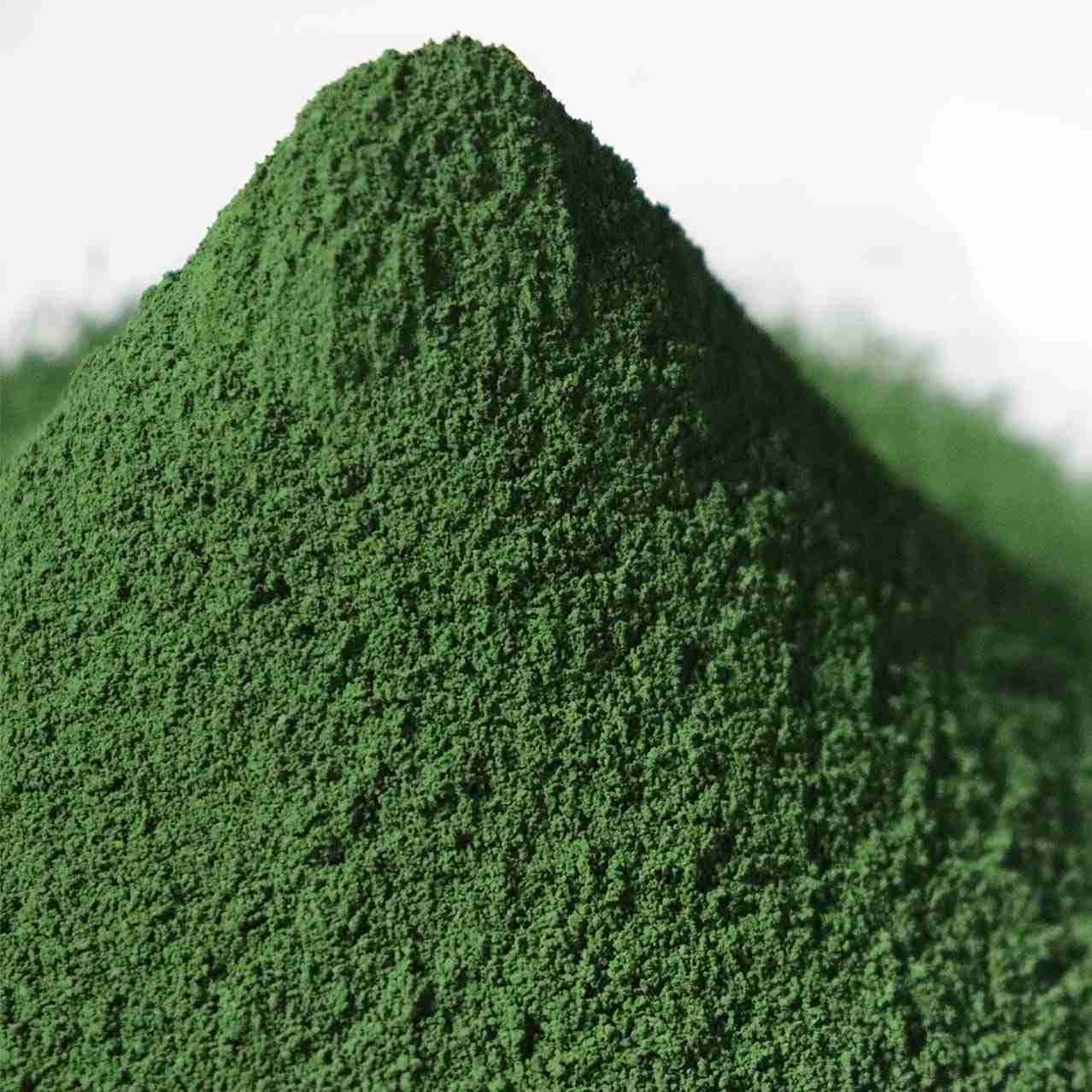
The traditional universal dry powder pigment — economical and practical, meeting most application scenarios.
Slurry-form chrome oxide green after secondary depolymerization and dispersion — superior usability and dispersibility compared with traditional dry powder.
Granulated pigment that dramatically reduces dust pollution in handling and dosing application scenarios.
The science behind the colour — crystal field theory in plain words.
In the hexagonal corundum lattice, Cr³⁺ ions sit in octahedral sites surrounded by oxygen. The five d-orbitals split into two energy levels — a gap that defines the colour.
Electrons absorb photons jumping between d-levels: blue-violet light (400–500 nm) and red light (600–700 nm) are eaten. Green light (500–600 nm) is reflected back to your eye.
UV-Vis spectroscopy shows an absorption trough at 540–580 nm and a reflection peak near 550 nm — matching the typical CIE Lab coordinates L 35.2 · a −18.5 · b 12.7.
Industry articles written around these grades — how they perform, where they win, and how to specify them.
Request 50 g samples of two neighbouring grades — judge the chips in your own formulation within one week.
REQUEST SAMPLES